October 26, 2026

Posted on: 4/9/2026 | By Heather Sheffield

During a presentation to the State Board of Education (SBOE) Wednesday during its April 6–10 meeting, Texas Education Agency (TEA) Commissioner Mike Morath provided a data-heavy update on Texas’ teacher workforce, highlighting both progress and ongoing concerns about preparation, certification, and the profession’s long-term sustainability.
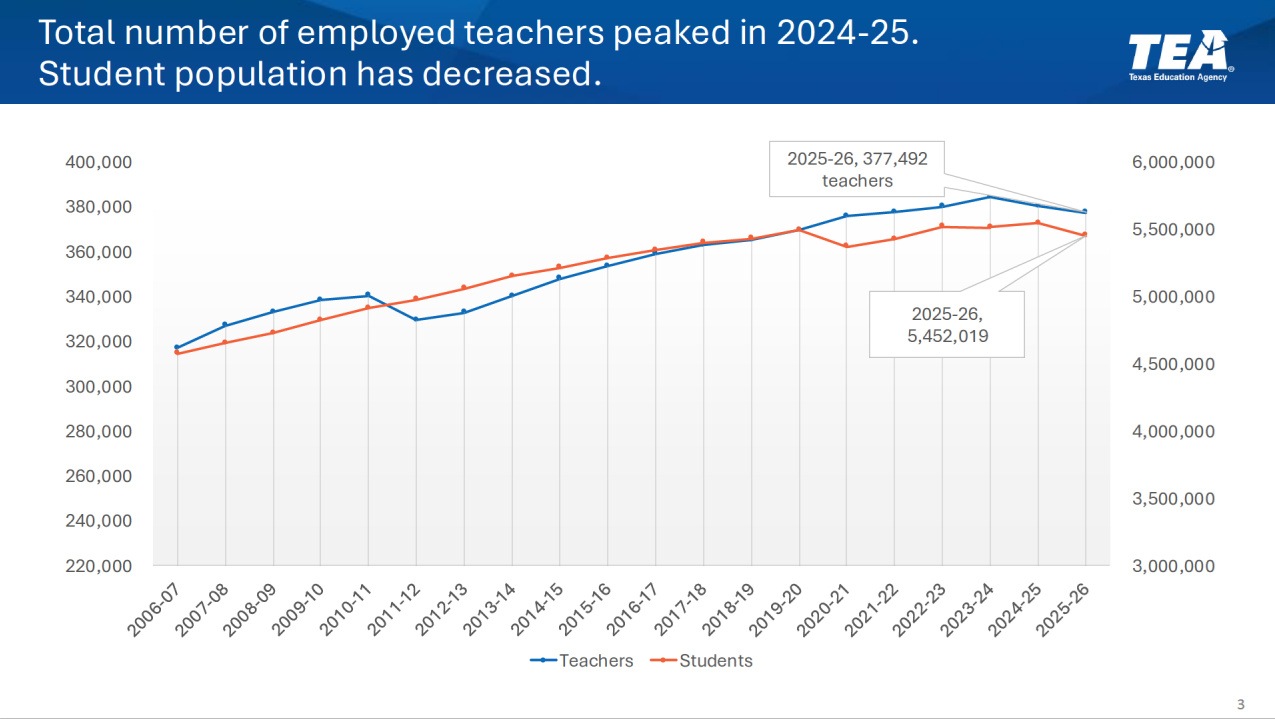
Morath opened by introducing a notable shift in statewide trends showing that while Texas continues to employ more teachers than any other state, student enrollment has declined. “We peaked in [teacher employment] … and since then, there has been more matching … to the student population,” he said, noting the state currently employs more than 377,000 teachers. At the same time, enrollment has dropped by tens of thousands of students in recent years, leading to smaller student-teacher ratios statewide.
Despite that, turnover remains a concern. The commissioner explained that teacher attrition has not returned to pre-pandemic levels: “The state hovered at roughly 10% attrition per year until COVID … we are improving, [but] we have not yet returned” to that baseline. He also emphasized that the state’s definition of attrition differs from what campuses experience. When a teacher leaves one school for another within Texas, the state does not count that as attrition, meaning campus leaders and educators may be experiencing much higher turnover than state data suggests. “Turnover rates are materially higher than this in all the schools,” he acknowledged.
On hiring, Morath pushed back on the idea that Texas cannot fill teaching positions. “We are hiring … we are filling vacancies,” he said. But he drew a distinction that will resonate with educators. Morath said: “That’s not the same thing as hiring trained, skilled individuals.” In the most recent year, Texas hired approximately 44,000 teachers, but fewer than half were fully trained, veteran educators.
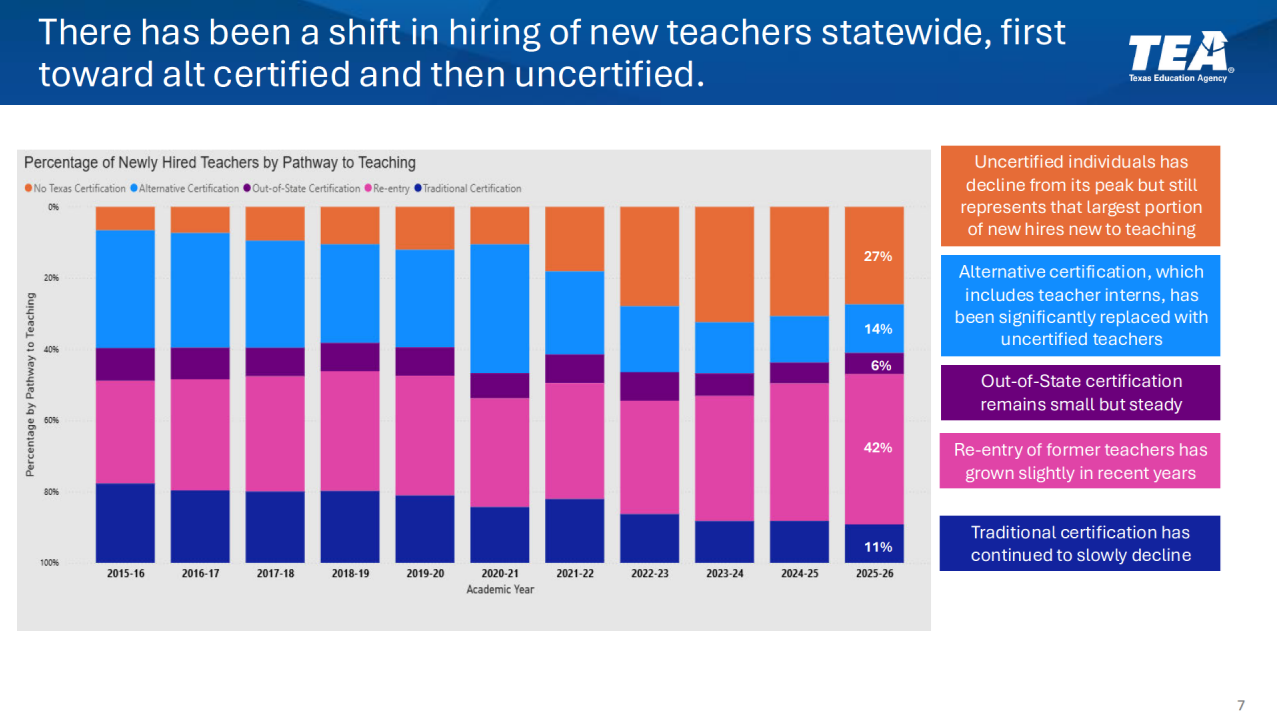
One of the most significant workforce shifts highlighted by Morath was the growing reliance on returning teachers. Educators returning to the profession, many of them experienced teachers coming back after time away, now make up the largest group of new hires, accounting for roughly 42%. “This is someone who actually does have teaching experience … generally a good situation,” he said.
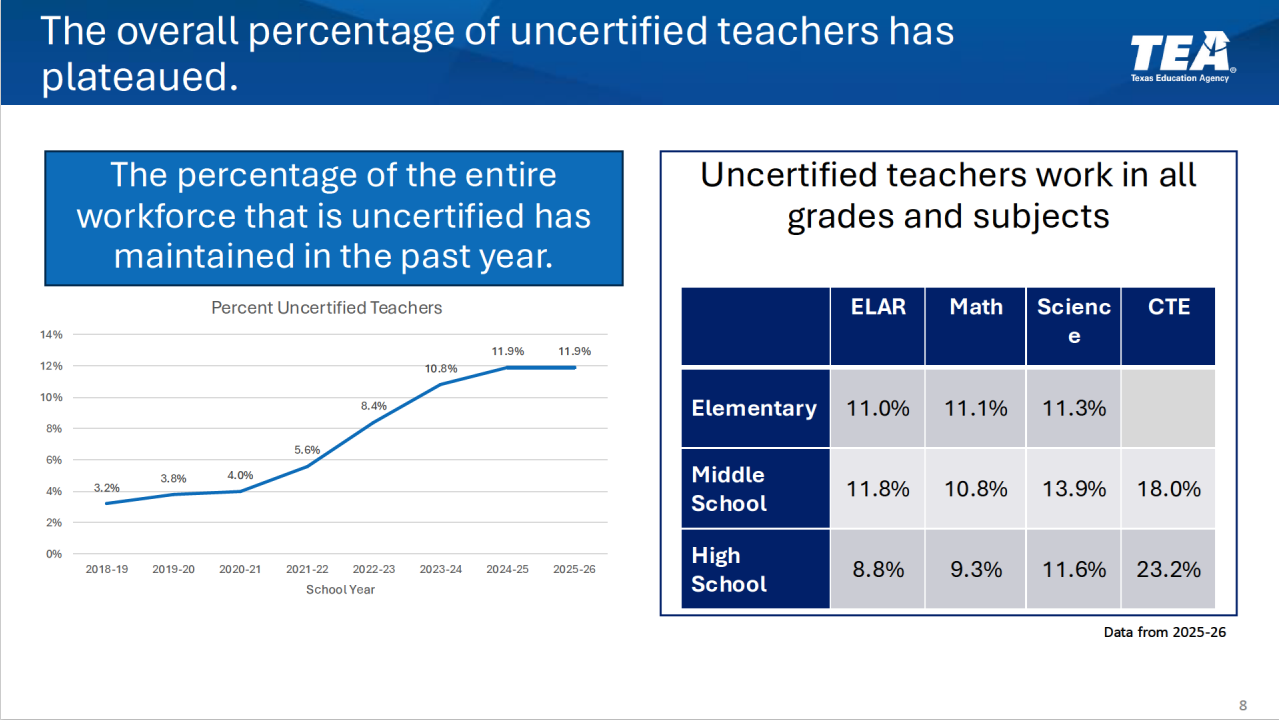
At the same time, the state continues to rely heavily on less traditional pathways. Morath acknowledged the increasing use of alternative certification and uncertified teachers, particularly in recent years. While the percentage of uncertified teachers has “plateaued,” he was clear about where this is most concerning: “Having an uncertified teacher is not problematic in CTE … but … in kindergarten … that’s not necessarily a good thing.”
The commissioner also pointed to a troubling trend in the teacher pipeline. While enrollment in educator preparation programs remains relatively stable, fewer candidates are completing the programs. “They’re not finishing the program at higher and higher numbers,” he said, attributing this in part to districts that hire candidates before certification is complete.
Much of Morath’s presentation focused on the state’s response to these issues through House Bill (HB) 2, which he described as a “historic” investment in the teaching profession. The law directs hundreds of millions of dollars toward recruiting, preparing, and supporting teachers, including expanding teacher residencies, paid student teaching, and mentorship programs. “The state has never really made a statewide investment in aspiring teachers,” he said.
A key goal of these changes is to reduce reliance on uncertified teachers in traditional school districts (not charter or private schools), particularly in core academic subjects. Morath outlined a multi-year transition plan to phase out uncertified hiring in those areas, supported by incentives such as $1,000 per uncertified teacher to help districts move staff toward certification. “We want a very small number [of teachers] to be uncertified,” he said. While the same rules do not apply to charter schools, the same incentives are offered to them.
The commissioner expressed optimism that these changes will improve retention over time, especially for early-career educators. “All evidence that we have is this should have a very significantly positive effect … on recruitment and retention,” he told SBOE members. He also acknowledged longstanding concerns from teachers about on-the-job support by saying: “We cannot be orphans … you cannot just put us into a classroom and not give us all the resources that we need.”
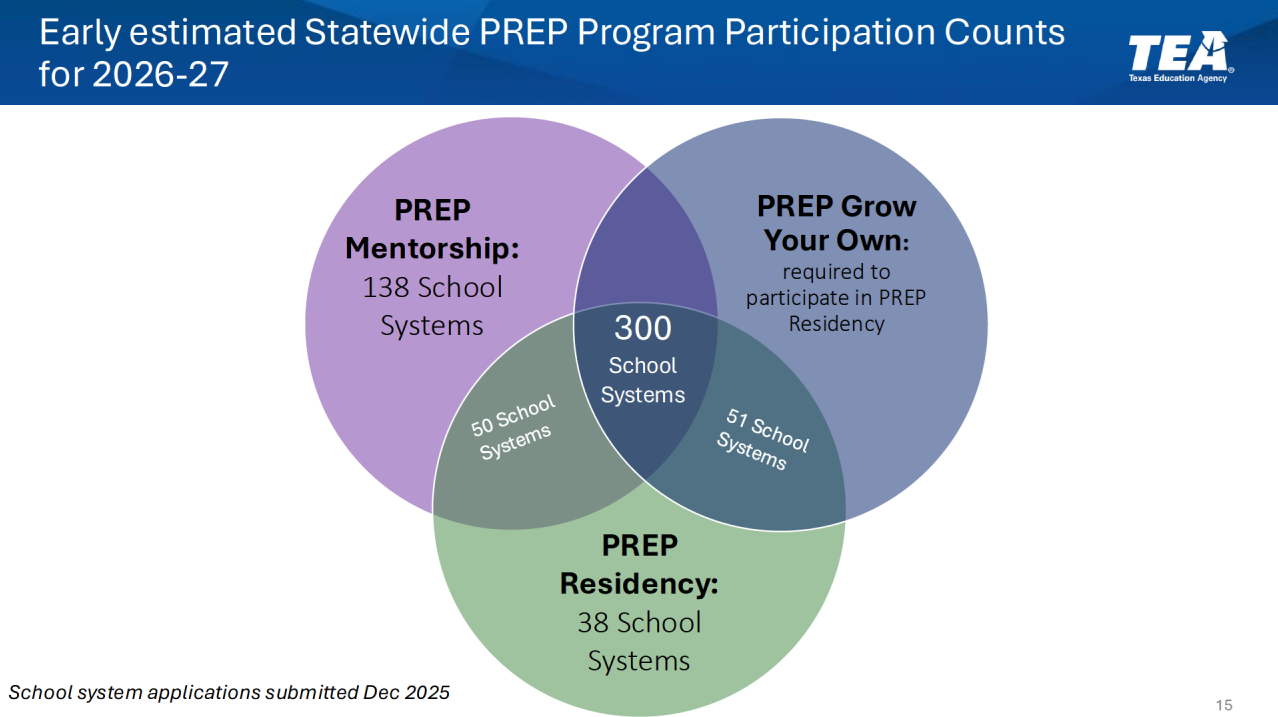
Looking ahead, Morath said the state expects about 300 school systems to participate in new preparation and residency programs in the coming year, with investments ramping up over time. However, he cautioned that results will not be immediate by saying that “Rome was not built in a day.”
From an educator perspective, many of the commissioner’s points align with what teachers have been saying for years. ATPE has consistently advocated for stronger preparation pathways, meaningful mentorship, and investments that treat teaching as a profession requiring training, not a job someone can simply “figure out” on the fly. The emphasis on residencies, paid student teaching, and mentoring reflects those priorities, and the recognition that uncertified teachers are particularly problematic in early grades is an important acknowledgment.
However, there are also areas in which ATPE would raise caution. Although the state may view teacher movement between campuses as a “win” for the system overall, that framing does not reflect the disruption experienced at the campus level. High turnover, regardless of whether teachers remain in public education, has real consequences for students, staff morale, and instructional continuity. Additionally, while the commissioner highlighted statewide hiring success, educators know that filling a position does not equate to stability or quality, particularly when districts must rely on underprepared or uncertified staff.
ATPE would also emphasize that preparation and certification alone are not enough to solve retention challenges. Working conditions, including workload, planning time, student discipline support, and access to high-quality materials remain central to whether educators stay in the profession. Investments in pipelines must be matched with sustained attention to the day-to-day realities educators face.
For educators and districts, the message is clear: Texas is entering a transition period. The state is making appreciated and much-needed investments significant in nature to rebuild the teacher pipeline and reduce reliance on uncertified teachers, but those changes will take years to fully materialize. In the meantime, many campuses will continue to navigate staffing shortages, uneven preparation levels, and turnover (higher than prepandemic levels) on top of budget deficits and reductions in force (hopefully primarily through attrition—for now).
In the near term, educators may see expanded mentorship opportunities, new residency partnerships, and additional support for certification, with $1,000 per teacher going to school systems to incentivize this. Over time, these efforts could lead to a more stable and better-prepared workforce. However, for now, the gap between statewide data and classroom reality remains, and educators will continue to feel the effects of that disconnect in their daily work. Ultimately, whether these policy shifts succeed will depend not only on how many teachers Texas hires but also on how well the state supports them once they enter, and remain in, the profession.